

The world’s tallest bridge: China’s engineering marvel
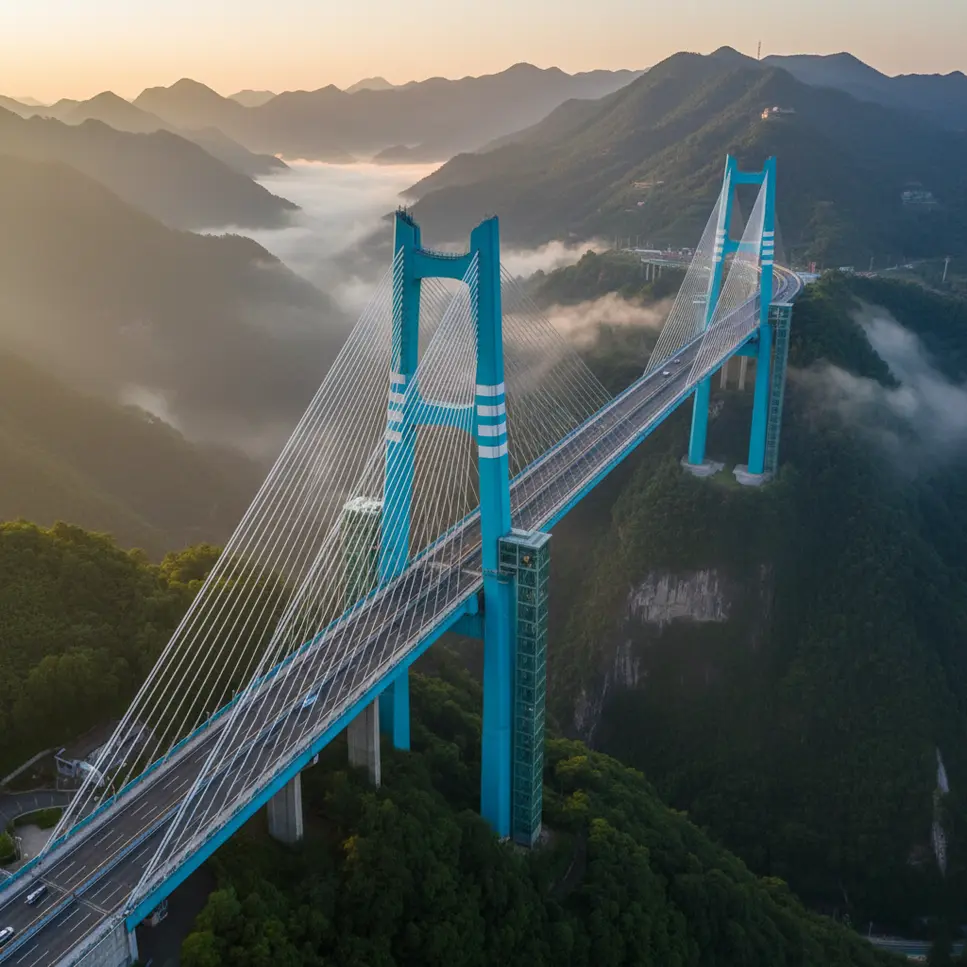
In the heart of China’s Guizhou province, an extraordinary engineering achievement has transformed the landscape and the daily lives of its residents: the world’s tallest bridge, the Huajiang Valley Bridge. Rising 625 meters above the valley floor and spanning nearly three kilometers, this monumental structure showcases unparalleled advances in construction technology and civil engineering, solidifying China’s position as a global leader in infrastructure innovation. This article explores the technical, economic, and social nuances that make this project an engineering marvel, shedding light on its design complexities, construction methods, and broader impacts.
- Overview of the Huajiang Valley Bridge’s technical features and architectural innovations
- Detailed analysis of construction systems including modular assembly and cable hoisting
- Quantitative data on dimensions, materials, and construction timeline
- Contextualization within China’s infrastructure development and global benchmarks
- Insight into socioeconomic effects and unanswered environmental considerations
Engineering Excellence: Technical Innovations Behind the Bridge
The Huajiang Valley Bridge embodies a pinnacle of engineering brilliance, primarily driven by a sophisticated cable hoisting system controlled with satellite precision. This system, recognized as the largest cable crane setup globally, enabled the safe and precise installation of 93 individual beam segments, each weighing up to 215 tons. Integration of real-time monitoring technology was critical, employing high definition cameras and distributed sensors to ensure structural integrity during construction. These state-of-the-art devices streamed data into advanced digital platforms that utilized 3D simulations and artificial intelligence algorithms to predict stresses and potential weaknesses in real time, thus guaranteeing a seamless and secure assembly process over challenging terrain.
Moreover, given the region’s seismic activity, the installation of specialized vibration sensors was paramount. Strategically embedded within the massive hollow columns, these sensors continuously monitor structural responses to minor tremors, providing an early warning system and enhancing safety. The bridge also features a modular assembly technique, a method that revolutionizes traditional construction by allowing smaller prefabricated components to be transported and efficiently assembled onsite, significantly reducing risks and construction timelines in this remote, mountainous environment.
Historical and Market Context: Transforming Guizhou’s Infrastructure
Guizhou province is renowned for its rugged mountainous geography, historically limiting connectivity and economic development. The Huajiang Valley Bridge is one of approximately 50 of the world’s 100 tallest bridges located in this region, underscoring China’s strategic focus on overcoming natural barriers through mega infrastructure projects. Construction began in January 2022 and reached completion in January 2025, a remarkably short three-year period for such an ambitious undertaking.
The financing and engineering oversight by Guizhou Transportation Investment Group and Guizhou Bridge Group, led by chief engineer Wu Chaoming, reflect China’s commitment to integrating cutting-edge engineering with economic development policies. This bridge drastically reduces travel time between key cities like Guang and Anchun from two hours to merely two minutes, fostering regional integration and stimulating commerce, tourism, and social exchange. Such infrastructure advances align with global trends prioritizing connectivity in geographically challenging areas, emphasizing sustainable economic growth and enhanced life quality for local populations.
Technical Data: Structural Specifications and Materials
The Huajiang Valley Bridge stands as an engineering titan: 625 meters in height with a total length of 2,890 meters, including a main span of 1,420 meters. Structural ingenuity is evident in the choice of materials — approximately 49,000 tons of steel, over 21,000 tons dedicated to the segments of the bridge deck, and 9,000 tons of suspension cables. The hollow columns strategically designed to be lightweight yet tremendously strong demonstrate advanced material science application, combining reinforced concrete with additional steel to maximize load-bearing capacity and durability.
- Height: 625 meters, making it the tallest bridge on the planet
- Total length: 2,890 meters, integrating multiple spans to overcome geographical obstacles
- Main span: 1,420 meters providing a record-breaking unsupported distance
- Steel used: ~49,000 tons ensuring strength and resilience
- Construction duration: 3 years, an accelerated timeline given the scale and complexity
“The combination of modular assembly and intelligent monitoring systems has redefined what is achievable in super-large infrastructure projects, setting new international benchmarks.”
International Benchmark: Setting Global Standards
When contextualized against global peers like the Millau Viaduct in France and the Akashi Kaikyō Bridge in Japan, the Huajiang Valley Bridge pushes the envelope not just in height but also in integrating technological innovations such as AI-driven monitoring and satellite-controlled hoisting systems. Whereas the Millau Viaduct pioneered cable-stayed design and streamlined construction, the Huajiang bridge advances these technologies with higher sensor density and real-time analytics, enhancing safety and operational efficiency. This project exemplifies how modern engineering can leverage digital tools in tandem with traditional civil techniques to build safer, more resilient, and future-ready infrastructure.
Socioeconomic and Environmental Impact
The bridge’s completion has yielded immediate economic benefits by drastically reducing transport time and boosting regional collaboration. Enhanced connectivity creates new opportunities for local communities, accelerating urbanization and diversifying economic activities, including tourism and trade. Socially, the structure bridges historically isolated areas, fostering inclusivity and greater access to services across Guizhou. However, despite the advances, the environmental impact remains an open question. The publicly available information excludes detailed analyses concerning waste management, ecosystem disruptions, or sustainability strategies during construction—a notable oversight given the area’s ecological sensitivity and seismic risk.
- Economic integration enabled by a 98% reduction in travel time
- Social benefits through improved connectivity between Guang and Anchun cities
- Environmental considerations are currently underreported, signaling a need for transparent sustainability assessment
Future Perspectives and Recommendations
Looking ahead, infrastructure projects of this magnitude will increasingly rely on smart technologies and sustainable construction practices. This bridge serves as a blueprint for combining precision engineering with digital innovation, yet also highlights critical gaps in environmental accountability. Future endeavors should incorporate rigorous environmental monitoring from the planning stage through to operational phases, ensuring ecological preservation alongside engineering ambition. Additionally, fostering international collaboration and knowledge sharing can help optimize construction methodologies and sustainability protocols worldwide.
“Balancing engineering marvels with ecological responsibility is the defining challenge for 21st-century infrastructure.”
Frequently Asked Questions
What technological innovations underpin the Huajiang Valley Bridge’s construction?
The bridge’s construction utilized a satellite-controlled cable hoisting system, high-definition real-time cameras, distributed sensors for structural monitoring, 3D simulation digital platforms, AI-driven predictive analysis, and modular assembly of prefabricated segments, enabling precise and safe construction in a geologically challenging area.
How does the bridge impact local travel and economy?
It reduces travel time between major cities from two hours to two minutes, accelerating regional integration, fostering economic development, improving logistics, and expanding tourism opportunities in previously isolated mountainous regions.
Are there concerns about the environmental impact of the construction?
While the bridge’s technological and economic impacts are well documented, detailed information on environmental assessments, sustainability measures, and waste management during construction remains absent, representing a critical area for future transparency and study.
Leia também
Para os profissionais e interessados em engenharia, a Huajiang Valley Bridge é um marco que demonstra o potencial da inovação tecnológica aliada à expertise construtiva. Compartilhe e comente para expandirmos o debate sobre futuros empreendimentos que unem robustez estrutural, sustentabilidade e avanços digitais para preparar o planeta para as próximas décadas.