


International Crew Arrives at Space Station: A New Era in Collaborative Spaceflight
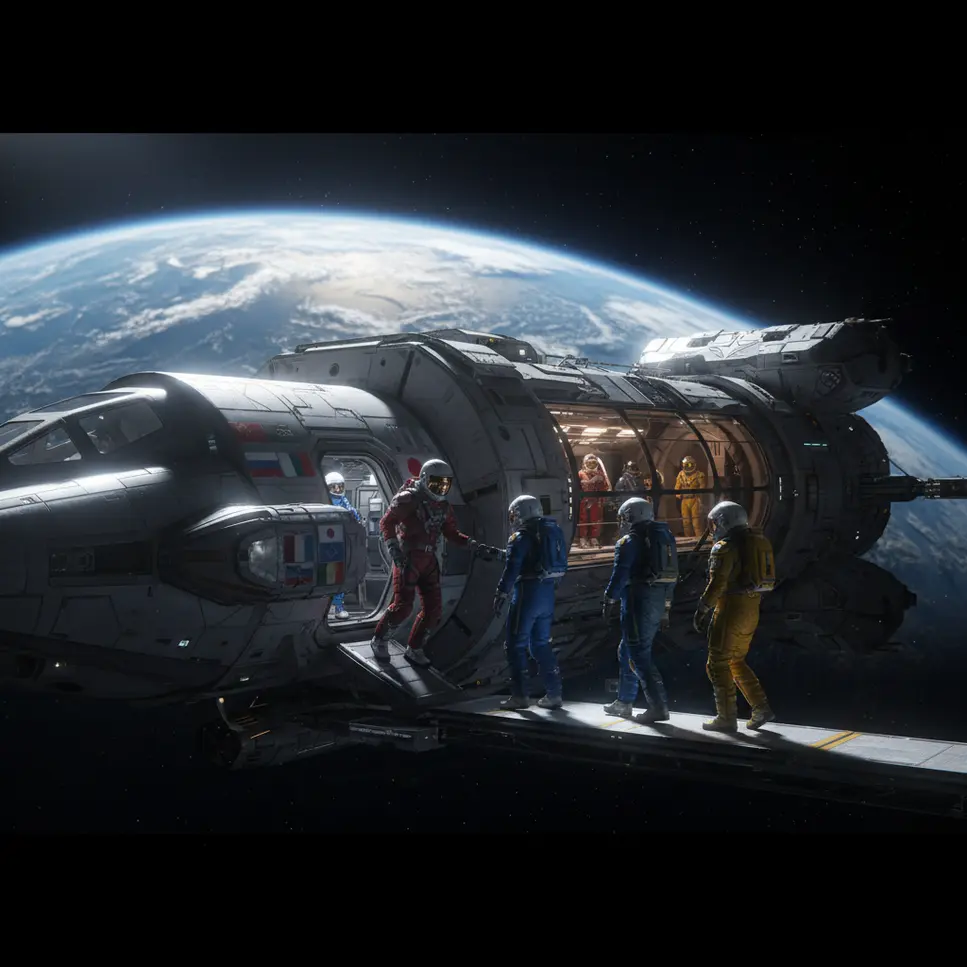
The successful arrival of an international crew aboard the Crew Dragon “Freedom” spacecraft marks a significant milestone in human space exploration, underscoring a new chapter of global cooperation and technological sophistication. This mission, executed by leading aerospace entities such as SpaceX, Roscosmos, and Boeing, manifests the cutting-edge advancements in spacecraft design, launch vehicle reuse, and orbital operations. With an 8-to-9-month tenure planned aboard the International Space Station (ISS), the seven-member crew stands testament to decades of engineering progress and international collaboration. The intricate phasing maneuvers and precise docking protocols demonstrate the rigor and precision required to sustain human presence in low Earth orbit, fostering an environment ripe for scientific innovation and multicultural exchange.
- Crew Dragon “Freedom” docked at the Zenith port of Node-2 (Harmony) following 34 hours of orbital phasing;
- Falcon 9 rocket’s first stage achieved successful recovery at Landing Zone 40, highlighting reusability advantages;
- Launch commenced on 13 February 2026 early morning EST, with docking realized on 14 February, culminating in the integration of seven crew members aboard the ISS Exped 74;
- Collaborative framework involves SpaceX, Roscosmos, and Boeing, reflecting a broader trend towards commercial missions and interagency partnerships;
- Environmental and economic impacts include cost reductions and emission minimization through orbital operational strategies.
Technical Overview of the Crew Dragon “Freedom” Mission
The Crew Dragon “Freedom” spacecraft executed a flawless approach and docking at the ISS’s Node-2 Zenith port, an operation culminating after approximately 34 hours of phased orbital maneuvers. These phasing sequences demand comprehensive calculations of orbital mechanics, ensuring synchronization with the ISS trajectory for rendezvous and safety-critical docking. The launch vehicle, a Falcon 9 rocket equipped with a reusable first stage, demonstrated the increasing viability of cost-efficient space launch technology. Its touchdown at Landing Zone 40 exemplifies SpaceX’s commitment to sustainable spaceflight—remarkably reducing material waste, manufacturing time, and operational costs. Altogether, the technical proficiency displayed in this mission reflects both the robustness of the hardware and the dexterity of mission control procedures, setting a precedent for upcoming space expeditions.
Historical Context and Market Dynamics
The evolution from government-exclusive space missions towards a blend of commercial and multinational efforts has reshaped the aerospace landscape over the past two decades. The ISS, a symbol of international collaboration among NASA, ESA, Roscosmos, and other partners, now regularly hosts crews launched by diverse contractors including SpaceX’s Crew Dragon and Roscosmos’ Soyuz vehicles, alongside Boeing’s Starliner. This pluralistic approach accelerates innovation, reduces system redundancies, and enhances mission resiliency. The increasing role of private industry is pivotal, not only in cost efficiency but also in operational agility. This shift embodies a broad paradigm wherein commercial spaceflight serves as an integral component of national space agencies’ strategic ambitions, ultimately democratizing access to low Earth orbit and fostering a vibrant space economy.
Data and Mission Parameters
Launched on 13 February 2026 at 5:15 a.m. EST (10:15 GMT), the mission promptly entered a detailed sequence of orbital insertions and speed adjustments to phase with the ISS. Approximately 34 hours later, the Crew Dragon successfully docked at the Harmony module’s Zenith port at 3:15 p.m. EST (20:15 GMT), followed by the crew ingress at 5:30 p.m. EST. The planned mission duration is between eight to nine months, during which the seven-person Expedition 74 crew will continue essential research and station maintenance tasks. The crew composition represents an amalgamation of seasoned astronauts from three agencies, enhancing the ISS’s operational capacity and contributing to its ongoing role as a microgravity laboratory for diverse scientific inquiries.
International Comparisons and Collaborative Benchmarking
The multifaceted collaboration among SpaceX, Roscosmos, and Boeing mirrors initiatives seen in other international aerospace partnerships, such as the European Space Agency’s cooperation with NASA and JAXA. While SpaceX’s advances with reusable launch systems place the U.S. at the forefront of commercial spaceflight, Russia’s Soyuz vehicles maintain proven reliability crucial for redundancy. Boeing’s Starliner introduces further competition and diversity in crewed spacecraft options. Globally, this multi-provider model not only mitigates risks associated with single-source dependencies but also inflames competitive innovation. The ISS remains the epitome of such synergy, a floating laboratory sustained by collective ingenuity. This model contrasts with historic Cold War-era space endeavors, highlighting societal and scientific progress towards cooperative exploration.
Environmental, Economic and Social Impact
The mission offers clear economic benefits by employing the Falcon 9’s reusable first stage, which significantly reduces launch costs, conserves materials, and accelerates turnaround times between missions. Environmentally, operations in low Earth orbit circumvent terrestrial emissions, and reusable launch vehicles mitigate debris and production waste. Socially, the seven diverse crew members from three distinct space agencies exemplify intercultural collaboration, promoting goodwill and shared scientific advancement. Their joint efforts aboard the ISS confirm the station’s role as a beacon of peaceful international cooperation, inspiring future generations to pursue STEM fields and global teamwork in the challenging arena of space exploration.
Future Perspectives and Recommendations
Looking forward, missions of this nature are expected to increase in frequency and complexity, driven by the proliferation of commercial space enterprises and expanded international partnerships. However, attention must be focused on transparent dissemination of research outcomes to maximize scientific yield and public engagement. Experts recommend enhanced integration of experimental data sharing alongside clear communication on mission objectives. Moreover, development of next-generation spacecraft that prioritize sustainability, crew safety, and modular upgradeability will be paramount. Governments and private entities should continue fostering cooperative frameworks that balance competition with collaboration, ensuring resilient and adaptable human presence beyond Earth’s atmosphere.
Summary of Key Points
- Precise orbital phasing and docking maneuvers of Crew Dragon “Freedom” underline advanced engineering capabilities.
- Falcon 9 reuse offers significant economic and environmental benefits, setting industry standards.
- International collaboration among SpaceX, Roscosmos, and Boeing reflects evolving commercial and geopolitical dynamics.
- The ISS continues to serve as an essential platform for scientific experimentation and cultural integration in space.
- Future missions should prioritize enhanced transparency on scientific objectives and sustainable spacecraft design.
Frequently Asked Questions (FAQ)
Leia também
Referências Internacionais
O êxito dessa missão pode ser comparado às recentes operações da ESA em parceria com NASA, como evidenciado durante a expedição Mars Analog que simulou condições de permanência prolongada em ambientes hostis. Essa convergência de conhecimento destaca a importância de plataformas internacionais para fomentar pesquisas e desenvolvimento tecnológico, inspirando novas fronteiras de exploração espacial. A referência à colaboração ESA-NASA é um benchmark de sucesso em alianças espaciais globais.
“A reinvenção do acesso ao espaço, apoiada por parcerias internacionais, é o caminho para uma exploração mais sustentável e inclusiva.” – Dr. Elina Kovalainen, especialista ESA em exploração humana.