

Austria Unveils Armed Camcopter S-301: A New Era in Tactical VTOL UAVs
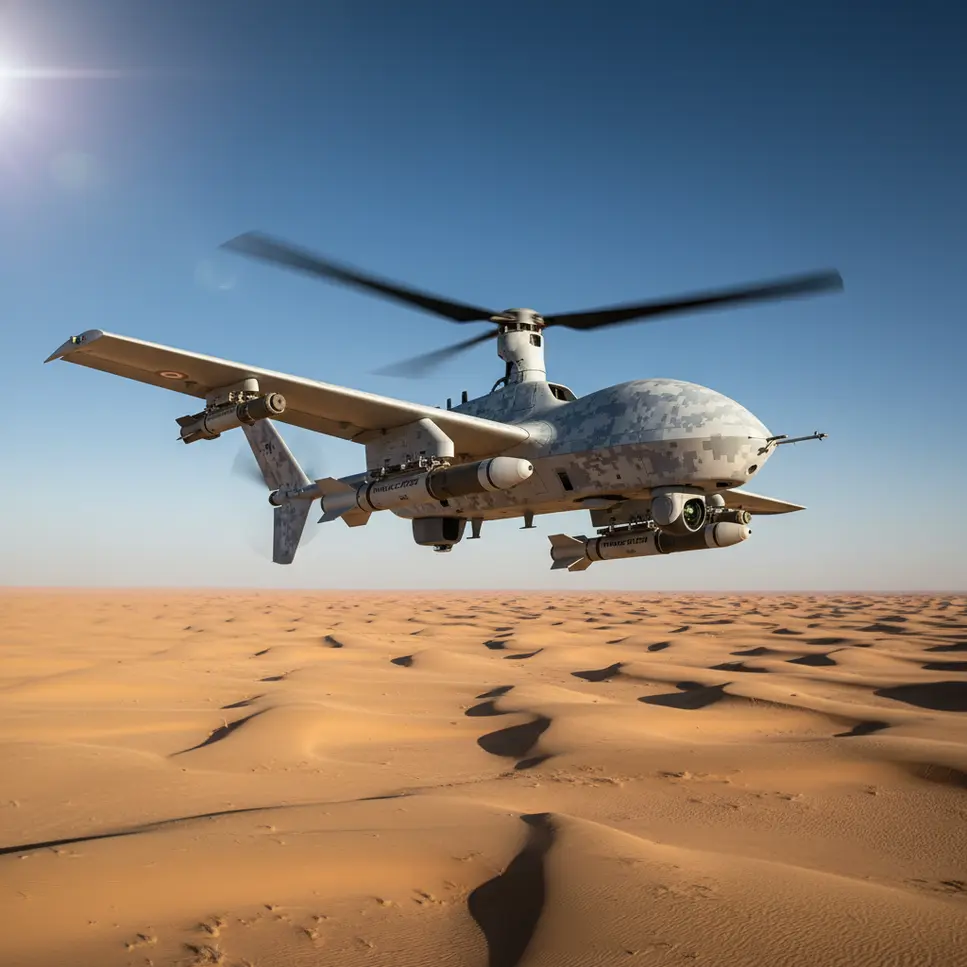
Recent developments in unmanned aerial systems have marked a significant leap in tactical capabilities and defense technology. Austria’s unveiling of the armed Camcopter S-301, presented at UMEX 2026 in Abu Dhabi and announced earlier at DSEI 2025, represents a sophisticated fusion of vertical take-off and landing (VTOL) capabilities combined with precision strike armament. This cutting-edge UAV is poised to reshape the market landscape by integrating advanced missile systems, sensors, and electronic warfare technologies. Its design reflects both strategic military demands and evolving threat environments, particularly in counter-drone operations and precision engagement.
- Vertical Take-Off and Landing (VTOL) capabilities with flexible payload options
- Integration of Thales FZ275 laser-guided rockets for precision strike
- Advanced sensor suite including EO/IR and synthetic aperture radar (SAR)
- Extended operational endurance paired with efficient heavy-fuel engine
- Market positioning amidst NATO VTOL systems and drone armament trends
Technical Features and Innovations of the Camcopter S-301
The Camcopter S-301 is distinguished by its VTOL capability, allowing it to take off and land without the need for runways or specialized infrastructure. This flexibility considerably enhances mission deployment in austere or contested environments. The aircraft can carry payloads ranging between 110 and 340 kilograms, accommodating sophisticated sensor arrays and armament. Notably, it integrates dual pods equipped with Thales FZ275 laser-guided rockets, providing a cost-effective precision strike solution capable of neutralizing various threats with minimal collateral damage.
Complementing its offensive potential, the S-301 is outfitted with an extensive sensor suite, incorporating electro-optical/infrared (EO/IR) imaging, synthetic aperture radar (SAR), and electronic warfare (EW) systems. This constellation of sensors enables resilient detection, tracking, and engagement capabilities across a spectrum of challenging environmental conditions and threat profiles. Furthermore, the UAV operates on a heavy-fuel engine compatible with NATO logistics standards, optimizing endurance with an operational flight time varying from 10 to 24 hours and an altitude ceiling reaching 5,500 meters.
Historical and Market Context
The development of weaponized unmanned aerial systems has accelerated significantly over the last decade, influenced heavily by recent conflicts such as the war in Ukraine which demonstrated the pivotal role of drones in modern warfare. Austria’s Camcopter S-301 enters a competitive market primarily shaped by NATO member states and legacy players like Schiebel with their S-100 and S-101 models. The increasing trend toward drone armament for counter-drone operations addresses emerging aerial threats, reflecting the global shift towards integrating artificial intelligence and autonomous features within electronic warfare domains.
In this context, the S-301 offers a potent alternative by focusing on affordable armaments—such as the FZ275 rockets—that reduce reliance on costly interceptor missiles. This approach aligns with evolving doctrines emphasizing persistent surveillance and precision engagement while maintaining budgetary efficiencies, a key differentiator in today’s defense procurement climate.
Operational Applications and Practical Deployment
The multifaceted capabilities of the Camcopter S-301 make it a versatile asset for diverse mission profiles, ranging from reconnaissance and intelligence gathering to targeted strike operations. Its VTOL design enables rapid deployment and recovery in confined or rough terrains, essential for dynamic battlefield conditions and urban warfare scenarios. The integration of laser-guided munitions enhances precision and lethality, suitable for both counter-drone operations and asymmetric engagements against lightly armored targets.
Key Operational Advantages:
- Reduced risk to human pilots by remotely conducting high-risk missions
- Extended loitering capability allowing sustained surveillance and strike readiness
- Lower operational costs through use of accessible rocket munitions
- Compatibility with existing NATO fuel infrastructure simplifying logistics
International Comparison and Benchmarking
When benchmarked against global counterparts such as the Schiebel S-100/S-101 and NATO VTOL unmanned platforms, the Camcopter S-301 stands out primarily for its payload versatility and advanced electronic warfare suites. While many systems currently prioritize endurance or stealth, Austria’s UAV emphasizes a balanced integration of sensor technology and precision strike weapons within a single platform. This approach offers a strategic edge in environments where multi-role capability and cost-effectiveness are paramount.
However, the explicit cruising speed remains unspecified, raising operational questions regarding its efficiency against high-speed jet-powered drones. Historical data from similar systems suggest limitations in intercepting agile aerial threats, an area requiring further validation and potential future upgrades.
Future Perspectives and Strategic Implications
Looking ahead, the Camcopter S-301 is positioned to catalyze further innovations in the tactical UAV domain. Its modular architecture and sensor fusion capability provide a solid foundation for integrating emerging technologies such as artificial intelligence-driven autonomy and enhanced electronic warfare countermeasures. The strategic evolution of armed drones increasingly reflects lessons learned from recent theatres of conflict, highlighting the importance of rapid adaptability and mission-specific configurations.
Continued refinement in propulsion technologies, sensor integration, and payload diversity will be critical to maintaining relevance in evolving threat landscapes. Austria’s focus on an economical yet potent weaponized UAV sets a precedent that may influence future NATO procurement strategies and collateral defense policies worldwide.
“The Camcopter S-301 embodies the next generation of tactical UAVs, emphasizing affordability, modularity, and precision in an increasingly contested aerial domain.” – Defense Technology Analyst
Impact Assessment and Recommendations
The emergence of the armed Camcopter S-301 carries multifaceted impacts that transcend pure military capabilities. Economically, the substitution of expensive interceptors with laser-guided rockets promises significant cost reductions in counter-drone operations, a growing expenditure for modern militaries. On the environmental front, the reliance on heavy-fuel engines aligned with NATO logistics logistics simplifies supply chains and may reduce emissions compared to conventional UAV propulsion systems.
Socially, the deployment of such systems mitigates risk to human pilots in volatile combat zones, emphasizing remote engagement and protection of personnel. Nevertheless, the challenge remains to address the UAV’s speed limitations to ensure operational effectiveness against fast, jet-powered drone threats. Ongoing field evaluations and iterative development cycles will be critical to optimize performance metrics and expand tactical applicability.
Recommendations for Stakeholders
- Prioritize testing of speed and interception capabilities against diverse A2/AD (Anti-Access/Area Denial) threats
- Invest in AI-enabled autonomy for enhanced real-time decision making and threat mitigation
- Leverage modular payloads to adapt rapidly to emergent mission profiles and threat environments
- Engage in multinational interoperability exercises to validate cross-compatibility within NATO frameworks
Frequently Asked Questions
What are the primary armaments of the Camcopter S-301?
The Camcopter S-301 is primarily equipped with dual pods of Thales FZ275 laser-guided rockets, which provide precision strike capability ideal for engaging drones and other tactical targets with reduced collateral damage.
What is the flight endurance and operational ceiling of this UAV?
The UAV can sustain flight for a duration between 10 to 24 hours, depending on mission configuration, with a maximum operational altitude of 5,500 meters, allowing flexibility across various theaters and mission profiles.
How does the Camcopter S-301 compare to similar NATO UAV systems?
Compared to NATO UAVs such as the Schiebel S-100 and S-101, the S-301 offers competitive payload versatility and a comprehensive sensor suite. While endurance and sensor integration are comparable, questions remain regarding its speed and ability to intercept jet-powered drones, a factor subject to ongoing evaluation.