


Replacement Crew Docks at International Space Station, Boosts Numbers Back to 7
Introduction
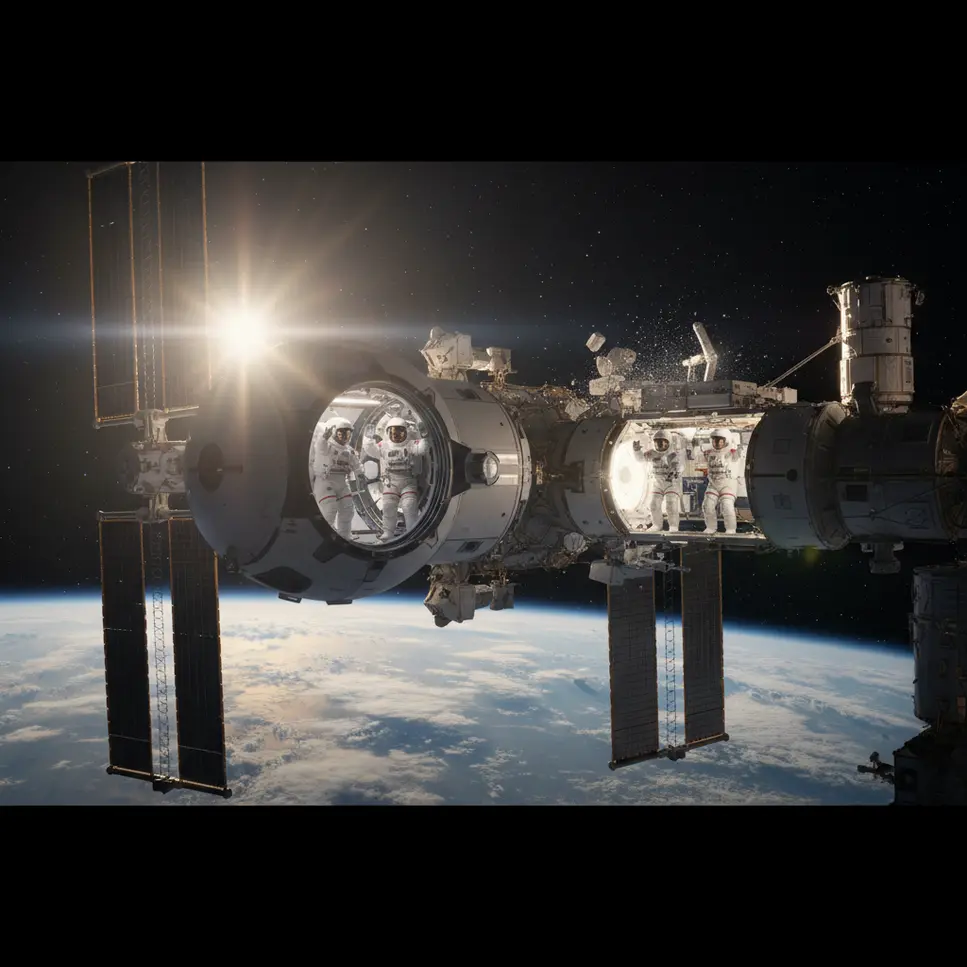
A recent critical mission marked a significant milestone in the ongoing operation of the International Space Station (ISS), as a replacement crew successfully docked, restoring the station’s onboard personnel to a full complement of seven astronauts. This event not only symbolizes the robustness of modern spaceflight logistics but also highlights the intricate coordination between international space agencies and private aerospace companies, ensuring continuous scientific research and station maintenance. The crew arrived via the SpaceX Crew Dragon capsule, launched on a Falcon 9 rocket from Kennedy Space Center, showcasing the latest capabilities in autonomous docking technology and rapid crew rotations driven by emergent medical situations.
- SpaceX’s Crew Dragon capsule performed autonomous docking at the ISS module Harmony.
- The replacement crew of four joined a total crew complement of seven aboard the station.
- Previous crew evacuated one month earlier due to a rare medical emergency.
- This mission paves the way for Artemis II and highlights international cooperation involving Roscosmos and ESA.
- Full crew numbers enable resumption of critical spacewalks and scientific experiments.
The Technical Landscape of ISS Crew Replacements
The replacement mission leveraged SpaceX’s latest advancements in spaceflight, utilizing the Crew Dragon capsule’s autonomous docking capabilities to seamlessly couple with the ISS’s Harmony module. This port, oriented towards open space, allows for optimal vehicle approach and integration. The Falcon 9 rocket launch vehicle remains a cornerstone for reliable ISS missions, showcasing reusable booster technology that reduces costs and turnaround times. Complementing these are the seasoned Soyuz spacecraft, still integral for Russian crewed missions, illustrating a hybrid approach blending private aerospace innovations with established governmental assets. The technical precision required for such docking maneuvers, conducted merely 34 hours post-launch, demands advanced navigation, sensor fusion, and automated control systems operating flawlessly in high-risk orbital environments.
Historical and Operational Context
The 14th of February 2026 docking came at a pivotal moment, following the early return of Crew 11 due to a medically necessitated evacuation, a first for NASA in 65 years, underscoring the complexities and risks inherent in prolonged orbital habitation. This repair in crew continuity restores the station’s capabilities at a critical juncture, aligning with preparatory efforts for Artemis II, scheduled for launch in March 2026. The international collaboration involving SpaceX, Roscosmos, and ESA, which included astronaut Sophie Adenot, demonstrates ongoing diplomatic and operational synergies that have sustained the ISS across decades. This mission exemplifies the station’s evolved response strategies for handling unforeseen contingencies while maintaining ambitious research agendas.
Data and Mission Specifics
- Launch Date and Vehicle: Falcon 9 launched Crew Dragon capsule from Kennedy Space Center on 13 February 2026.
- Docking Timestamp: 14 February 2026, 15:15 EST, approximately 34 hours post-launch.
- Crew Complement: Four new astronauts joined the ISS, restoring the total crew count to seven.
- Mission Duration: Estimated between 8 to 9 months, focusing on continued scientific research and station maintenance.
- Previous Crew Evacuation: Crew 11 returned one month ahead of schedule due to a medical emergency, the first NASA crew evacuation in over six decades.
Practical Applications and Operational Impacts
With the crew numbers restored to full capacity, the ISS can resume full-scale operations that were severely limited by the previous reduced crew of three. Importantly, the buddy system for extravehicular activities (EVAs) — critical for safety during spacewalks — is now fully functional, minimizing individual risk and maximizing mission efficacy. The reinstatement of a seven-member team accelerates research timelines, particularly in ongoing experiments related to life sciences, materials, and space agriculture, including pioneering methods of food production in microgravity. Economically, this reduces costly operational pauses and preserves the return on investment from extensive onboard research, reinforcing the station’s status as an indispensable orbital laboratory.
International Comparisons and Collaborative Dynamics
The mission highlights a unique blend of international cooperation and commercial innovation that positions the ISS program at the forefront of global space exploration. While Russia’s Soyuz spacecraft continue to play a crucial role in ferrying crews for Roscosmos, private-sector entities like SpaceX are driving down costs and enhancing mission flexibility. Similarly, ESA’s involvement through astronauts such as Sophie Adenot signifies deepening European commitment to sustained human presence in orbit. Comparatively, the ISS represents one of the most complex multinational engineering endeavors, contrasting with nations like China, whose independent Tiangong space station follows a more unilateral model but lacks similar international collaboration or commercial partnership scale.
Future Perspectives and Strategic Implications
Looking ahead, this mission sets a precedent for rapid crew replacement capabilities in the event of medical or technical emergencies, a crucial operational evolution as humanity prepares for longer-duration spaceflights such as Artemis II’s lunar ambitions. The inclusion of a requested surgeon post-docking for the current crew signals ongoing vigilance regarding astronaut health, a priority as missions extend in duration and distance. Strategically, the integration of commercial and governmental assets provides a resilient framework that could support future deep-space habitats, exemplifying modular and scalable crew transfer architectures. The lessons learned from this and similar missions will directly inform designs for crew safety protocols, medical contingencies, and autonomy in space navigation.
Impact Assessment and Expert Recommendations
“The restoration of the ISS crew to full strength is critical not only for maintaining ongoing research but also for ensuring the safety and operational readiness of future exploratory missions,” commented Dr. Elaine Rivers, aerospace systems analyst.
This replacement crew mission mitigates the operational bottlenecks caused by a reduced astronaut team while reinforcing the scientific output necessary for incremental advances in microgravity research. Experts recommend sustained investment in autonomous docking technologies, crew health monitoring systems, and international partnerships to preserve ISS functionality until its scheduled decommissioning. Furthermore, transparent reporting on medical contingencies, while respecting privacy, would benefit mission planners globally by providing precedents for emergency protocols. Expanding onboard medical capabilities and preemptive astronaut health assessments remain paramount for mission continuity.
- Enhance onboard medical intervention capabilities to reduce evacuation needs.
- Promote international data sharing for quick adaptation to unforeseen crew issues.
- Invest continuously in reusable launch vehicles to reduce mission costs.
- Increase scientific payloads focusing on long-duration human spaceflight risks.
Frequently Asked Questions (FAQ)
Leia também
Conclusão
A recente missão de substituição de tripulantes da ISS representa um avanço significativo não apenas pela resolução de um desafio emergencial de saúde, mas também por reforçar a confiabilidade das operações orbitais em um período de intensas preparações para o retorno humano à Lua. A combinação de esforços internacionais e o papel fundamental de empresas privadas como a SpaceX demonstram como o futuro da exploração espacial está ancorado na cooperação, inovação tecnológica e flexibilidade operacional. Ao garantir o habitat completo de astronautas, o ISS reafirma seu papel como laboratório vital para a humanidade, enquanto inspira confiança nas missões de longa duração que virão.
Compartilhe este conteúdo para manter sua rede informada sobre os avanços imperdíveis na exploração espacial e comente abaixo suas perspectivas sobre o impacto dessas operações no futuro da humanidade no espaço.